Why the Most Beautiful Plate We've Ever Served Looks Like Almost Nothing
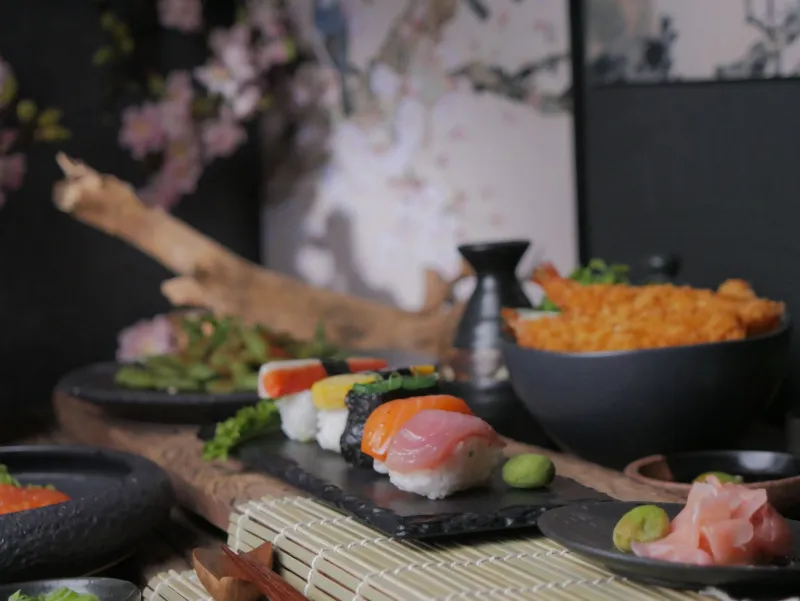
Open your phone right now and scroll through food content for about 90 seconds. What do you see? Towers of smash burgers dripping through their own architecture. Pasta pulled into long, glistening strands. Rainbow grain bowls arranged with the precision of a mosaic. Desserts that look less like food and more like architectural models of desserts. It's a visual language we've all learned to speak fluently — more color, more height, more drama, more sauce.
Now imagine a single ceramic bowl. Off-white, slightly irregular, clearly made by hand. Inside it, a few spoonfuls of rice, a curl of pickled vegetable, one small piece of fish the color of pale coral. A single cherry blossom petal — real, not decorative — resting at the edge.
That's it. That's the plate.
And somehow, it's the one people can't stop photographing.
The Problem with Maximalism
Food styling for social media has followed a predictable trajectory over the past decade. The pressure to create content that stops the scroll has pushed plating further and further toward the extreme — bigger portions, louder colors, more theatrical presentations. A dish that looks "normal" on a plate has almost no chance in a feed full of lava cakes and 12-layer nachos.
The result is a kind of visual inflation. Everything has to be the most. The most colorful, the most loaded, the most dramatic. And like all inflation, it has a cost: our ability to actually see food anymore.
At 36 Sakura Café, the design team made a deliberate choice to go in the opposite direction. Not as a gimmick, and not as a reaction to trends — but as a direct expression of the Japanese aesthetic philosophy that underpins everything the café does.
"We kept asking ourselves what the plate would look like if it didn't need to perform," says the café's head of culinary design. "What if it just needed to be true to the ingredient? That's a very different question than 'how do we make this photograph well.'"
Wabi-Sabi at the Table
The Japanese concept of wabi-sabi — the beauty found in imperfection, transience, and incompleteness — is not exactly a natural fit for American food culture. We like our plates generous and our presentations confident. The idea that a slightly asymmetrical bowl or a deliberately sparse arrangement could be more beautiful than a towering composed dish requires a real shift in how you look.
But that shift is exactly what 36 Sakura Café is asking of its guests.
The ceramics used here are sourced from small-batch makers whose pieces vary slightly from one to the next. No two bowls are identical. The glazes run unevenly. The edges aren't perfectly round. In a mainstream restaurant context, this would be a quality control problem. Here, it's the point.
When a piece of fish is placed in that bowl, the slight variations in the ceramic's surface change how the light falls. The irregularity of the glaze creates a kind of conversation with the food that a perfectly smooth white plate never could. The plate isn't a background. It's a collaborator.
What Happens When You Point a Camera at Stillness
Here's the counterintuitive part: the plates at 36 Sakura Café photograph extraordinarily well. Not in the way a towering dessert photographs well — not with drama and visual noise — but in the way a single flower in a field photographs well. There's nothing competing for your eye. The subject is the subject.
Food photographers who've shot the menu talk about the experience in almost meditative terms. "I had to slow down completely," says one freelance photographer who documented a seasonal menu last spring. "With most food, you're trying to capture energy. Here, you're trying to capture stillness. That's a completely different skill, and honestly, it's harder. But when you get it right, it's like nothing else."
The images that come out of 36 Sakura Café have a particular quality — quiet, almost contemplative — that stands out sharply in a social feed. In a stream of visual noise, silence reads as confidence. People stop scrolling not because they've been grabbed, but because they've been stilled.
The Irony of Going Viral by Opting Out
The café never set out to be Instagrammable. That's not a marketing line — it's a genuine design principle. The plating philosophy here emerges from a commitment to the ingredients themselves, to the Japanese tradition of letting food speak without decoration, and to the idea that a meal should be experienced rather than documented.
And yet the images circulate. They get saved and shared. People screenshot them and send them to friends with messages like "this is what I want dinner to look like." The aesthetic has accumulated a following precisely because it isn't trying to.
This is not as mysterious as it sounds. Social media audiences, like all audiences, are responsive to contrast. When everything around something is loud, the quiet thing stands out. When every plate is maximalist, the minimal plate becomes the radical one.
Eating What You Can Actually See
There's a practical dimension to all of this that doesn't get discussed enough. When a plate is sparse, you actually look at what's on it. You notice the texture of the fish, the color gradient in the pickled vegetables, the way the blossom petal has dried slightly at one edge. You see the food.
With a loaded plate, the eye doesn't know where to go. You eat through the chaos rather than into it. The individual ingredients disappear into the composition.
At 36 Sakura Café, every element on the plate was chosen carefully enough to deserve your attention. The plating philosophy is, at its core, an act of respect — for the ingredient, for the farmer or fisher who produced it, and for the person about to eat it.
Put your phone down for a second. Actually look at what's in front of you.
That's the whole idea.