A Table for One, Please — And Why That's Actually the Best Seat in the House
There's a moment most solo diners in America know well. You walk up to the host stand, and when they ask how many in your party, you say "just one" — and something almost apologetic sneaks into your voice without you even meaning it. The host smiles, maybe a beat too long, and leads you to a small table tucked near the kitchen or a corner booth that feels designed to minimize your visibility.
American dining culture, for all its innovation and enthusiasm, has never quite figured out what to do with the solo diner. We treat eating alone as a problem to be managed — something to get through quickly, or something to disguise with a book or a scroll through your phone. But here's the thing: that story is almost entirely a cultural invention. And if you want proof, you don't have to fly to Kyoto to find the alternative.
How Japan Rewrote the Rules on Eating Alone
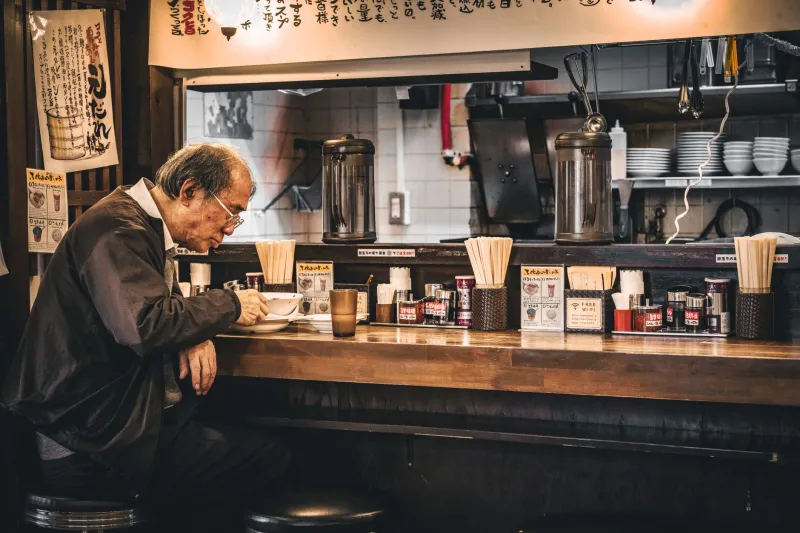
In Japan, solo dining isn't a consolation prize. It's practically an art form. The concept of ichiran — eating alone, fully absorbed in the experience — is baked into the culture in a way that has no real American equivalent. Walk into a traditional Japanese ramen counter and you'll find individual booths with partitions, designed specifically so a single diner can focus entirely on the bowl in front of them, without distraction, without self-consciousness, without the background noise of other people's conversations bleeding into your own headspace.
This isn't about isolation. It's about intention. There's a meaningful difference between being alone because no one showed up and being alone because you chose to be fully present with your meal. Japanese dining philosophy has understood that distinction for a very long time. The meal becomes the company.
And that shift in framing changes everything about how eating alone feels.
The Counter Seat Nobody Fights Over (But Should)
At 36 Sakura Café, the counter seating isn't an afterthought — it's arguably the most thoughtfully designed spot in the entire space. While groups and couples naturally gravitate toward tables, the counter offers something genuinely different: a front-row seat to the quiet choreography of the kitchen, a natural rhythm of interaction with the staff, and a kind of gentle accountability that makes you actually slow down and eat.
When you're at a table with friends, conversation fills every pause. The food becomes the backdrop. At the counter, the food becomes the foreground. You notice things you'd otherwise miss — the way steam rises from a bowl of miso, the precise moment a sakura-glazed dish catches the light, the careful arrangement of garnish that took someone real time and care to place just so.
There's also something quietly social about counter dining that defies the "eating alone" label entirely. You're not isolated. You're embedded. Staff check in naturally, without hovering. There's often easy, low-stakes conversation with whoever's working — the kind of unhurried exchange that's increasingly rare in daily American life. You leave feeling like you were somewhere, not just fed.
The Psychology of Eating With Yourself
Researchers studying eating behavior have found something that probably won't shock you once you hear it: people who eat mindfully — slowly, without screens, paying attention to taste and texture — consistently report higher satisfaction from their meals, even when the food itself is identical to what distracted eaters consume. The meal, in other words, is only part of what makes dining good. The attention you bring to it matters just as much.
Solo dining, done intentionally, is one of the most reliable pathways into that kind of presence. Without the social obligation to maintain conversation, your senses have nowhere else to go. The warmth of the broth, the slight bitterness of the matcha, the soft resistance of handmade noodles — these things stop being background and start being the whole point.
There's also a self-knowledge component that's easy to underestimate. Eating alone, regularly and without apology, is a low-key act of self-trust. You don't need an occasion. You don't need company to justify treating yourself to something good. You're enough of a reason on your own.
Why American Dining Culture Makes This So Hard
It would be unfair not to acknowledge that the stigma around solo dining in the US isn't just in people's heads — it's reinforced by real structural choices. Most American restaurants are designed for groups. Tables are sized for two minimum. Menus are priced and portioned with sharing in mind. Happy hour specials assume you brought a friend. Even the ambient noise levels in most popular American spots make quiet, contemplative eating pretty much impossible.
There's also the social media dimension. Food content performs best with context — the group dinner, the date night, the birthday celebration. A single beautiful bowl, eaten alone on a Tuesday because you wanted to, doesn't have an obvious narrative hook. So it doesn't get posted, and because it doesn't get posted, it doesn't get normalized, and because it doesn't get normalized, people keep feeling weird about doing it.
That feedback loop is worth breaking.
What Happens When You Just... Show Up
Here's what a lot of first-time solo diners at 36 Sakura Café describe: they walk in a little self-conscious, settle into the counter, and then — somewhere between the first sip of tea and the arrival of their main dish — something releases. The self-monitoring quiets down. The meal takes over.
By the time they leave, most people don't describe the experience as lonely. They describe it as grounding. Restorative, even. Like something got refilled that they hadn't noticed was running low.
That's the quiet promise of solo dining done right. Not loneliness, but the opposite — a kind of reconnection with yourself that's genuinely hard to find in a culture that's constantly pushing you toward noise, speed, and distraction.
So next time you're deciding whether to make a reservation for one, consider dropping the apology from your voice. You're not settling. You might actually be choosing the best seat in the house.