What Your Nervous System Already Knows: The Hidden Design Behind Japanese Restaurant Calm
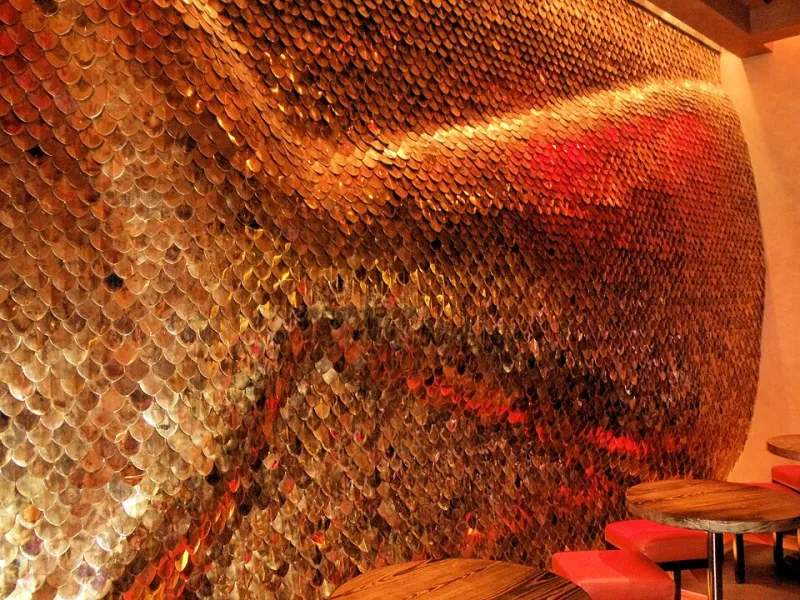
Photo: Jim G from Silicon Valley, CA, USA, CC BY 2.0, via Wikimedia Commons
Something strange happens about ten minutes into a meal at a well-designed Japanese restaurant. You realize you haven't checked your phone. Not because you decided to put it away. Not because someone asked you to. You just... forgot it was there.
For a lot of American diners, that moment is almost disorienting. We're so conditioned to the buzz and pull of notifications that their absence feels like something is missing — until it doesn't, and suddenly it feels like relief.
This isn't accidental. It isn't even particularly mysterious, once you understand what's actually happening in the room around you.
The Room Is Doing Something to Your Brain
Neuroscientists who study environmental stress have a term for what most American restaurants do to the human nervous system: sensory loading. Bright overhead lighting, hard surfaces that bounce sound, closely packed tables, background music calibrated to increase table turnover — all of it adds up to a low-grade state of alertness that keeps your fight-or-flight response gently ticking.
You don't notice it consciously. But your body does. Your cortisol levels stay slightly elevated. Your attention keeps scanning. You eat faster, talk louder to be heard over the noise, and leave feeling like you need another hour to decompress from the thing that was supposed to be relaxing.
Japanese restaurant design, at its most intentional, works in almost exactly the opposite direction.
"The goal isn't to create a dramatic or impressive environment," says one interior designer who has worked on Japanese hospitality spaces across the West Coast. "The goal is to create conditions where the nervous system stops defending itself."
What Negative Space Actually Does
One of the first things you notice at 36 Sakura Café — even if you can't name what you're noticing — is that there's room to breathe. Not just physically, but visually. Walls aren't crowded with décor. Tables aren't crammed together. There are deliberate patches of emptiness that Western design instincts might call wasted space.
In Japanese aesthetics, this is ma — a concept that roughly translates to meaningful negative space. It's the pause between notes in music, the gap between branches in an ikebana arrangement, the quiet corner of a room that isn't trying to tell you anything.
For your brain, that visual breathing room is genuinely restorative. Research in environmental psychology consistently shows that cluttered visual fields increase cognitive load — your brain has to work harder to process what it's seeing and decide what matters. Sparse, intentional spaces reduce that load. Your attention softens. Your body follows.
At 36 Sakura Café, the sakura motif plays into this beautifully. A single branch of cherry blossoms, rendered in soft ink on a panel near the entrance, does more psychological work than a wall covered in busy patterns ever could. Your eye finds it, rests there, and moves on. That's the point.
Sound Is the Hidden Variable
Ask most people what they find relaxing about a Japanese restaurant and they'll mention the food, the lighting, maybe the service. Very few will mention the acoustics — even though sound design may be the single most powerful factor at play.
Hard surfaces in a restaurant — concrete floors, glass walls, exposed brick — reflect sound rather than absorbing it. The result is a space where noise accumulates and amplifies. Studies have linked high restaurant noise levels to elevated heart rate, reduced enjoyment of food, and faster eating pace. Some researchers have found that diners in noisy environments actually taste food differently, perceiving less sweetness and subtlety in flavors.
Traditional Japanese design materials — wood, paper screens, woven textiles, tatami-inspired flooring — are, almost incidentally, excellent acoustic absorbers. Sound doesn't ricochet. Conversations stay contained. The ambient noise level drops to something closer to a living room than a sports bar.
"When you lower the decibel level in a dining room, you lower the volume of the whole internal experience," explains one acoustics consultant who has worked with hospitality designers in New York and Los Angeles. "People start speaking more quietly, which lowers the noise further. It becomes self-reinforcing."
At 36 Sakura Café, this effect is deliberate. The materials were chosen not just for how they look, but for how they behave with sound. The result is a room where you can actually hear your dining companion without leaning in, where silence between sentences doesn't feel awkward, where your own thoughts get a little quieter.
Light That Doesn't Push You Around
American restaurant lighting tends to fall into two camps: aggressively bright (fast casual, diners) or dramatically dim (date-night spots where you can't read the menu). Both are, in their own ways, telling your nervous system something is happening.
Japanese lighting philosophy aims for something different — warmth without drama, visibility without glare. Think the quality of late afternoon light filtering through a paper shoji screen. Soft. Diffuse. Not asking anything of you.
This kind of lighting has measurable effects on the body. Harsh overhead light suppresses melatonin and keeps your alertness response engaged. Warm, indirect light signals the brain that it's okay to shift into a lower gear — the same neurological gear you're supposed to be in when you're genuinely resting.
At 36 Sakura Café, the lighting was specifically designed to evoke that filtered, gentle quality. The sakura-toned warmth isn't just pretty — it's functional. It's telling your body: you can slow down now.
Why Your Phone Loses Its Grip
Put all of these elements together — reduced visual clutter, softened acoustics, gentle lighting, a sense of unhurried space — and something interesting happens to your relationship with your phone.
Phone-checking is, at its core, a response to ambient stress and boredom. When our environment keeps our nervous system slightly activated, we reach for stimulation to match that activation level. When the environment genuinely calms us down, the pull of the device weakens. There's simply less gap to fill.
This is why the phone-forgetting moment feels so notable when it happens. It's not willpower. It's the room doing its job.
"We don't tell people to put their phones away," says one of the team members at 36 Sakura Café. "We just try to give them somewhere better to be."
A Different Kind of Dining
American dining culture is, in a lot of ways, built around stimulation. Big flavors, big portions, big noise, big energy. There's nothing wrong with that — sometimes that's exactly what you want.
But there's a growing appetite for something else. For a meal that feels like a genuine pause. For a space that asks nothing of you except to be present in it. For the particular kind of rest that only comes when your environment stops competing for your attention.
That's what the design philosophy at 36 Sakura Café is reaching for. Not silence for its own sake, but the conditions under which you can actually hear yourself think — and then, for a little while, stop thinking altogether.
The cherry blossoms on the wall aren't just decoration. The quiet room isn't just a stylistic choice. Every element is working together toward a single goal: giving your nervous system permission to exhale.
Your phone will still be there when you leave. It'll keep. The meal won't.